

Table of Contents
What initially drew you towards the legal profession? Was it a conscious calling, an influence of circumstance, or a gradual realization shaped by early experiences?
I come from a generation where career planning was unknown to parents or the Candidates concerned and everything was left to destiny. I come from a trading family of moderate means doing business at a small town Jaora, Dist. Ratlam (M.P.), even now a sub- divisional headquarter. I am not only first generation lawyer but in true sense only one generation lawyer. I was the first matriculate in four generations above me and also the only lawyer in the four generations below me. My joining legal profession was a verdict of destiny and a matter of chance. My academic career has been brilliant. I am a gold medalist in law of the year 1962 with a great predecessor, CJI R.C Lahoti, who was the gold medalist of the same university in 1961.
Who were your early mentors in the profession, and what did you imbibe from them that continue to guide you even today? Are there particular lessons – ethical, intellectual, or strategic that have remained foundational in your practice?
The luckiest thing that can happen in the legal profession is association of a learned and ethically upright senior. The destiny could not have been more kind to me in this regard. I enjoy the privilege of being the only junior of Late Justice G.G. Sohani from 1962 till his elevation in 1973. His analytical study and logical presentation of a case had the highest impact on my style of functioning as an advocate. In addition, association of stalwarts of that era namely Shri K.A. Chitale and Shri S.D. Sanghi and intimate friendships with Late Shri M.L. Agarwal, advocate and Late Shri Justice R.K. Vijaywargiya (known for his impeccable neutrality) had great impact in my formative years. They are all no more and I miss them.
You were the topper of the Madhya Pradesh Civil Judge Services at the young age of 24. Could you take us back to those formative days? What prompted your decision to resign from judicial service and to re-join the Bar? Were there uncertainties associated with that transition, and how did you overcome them?
The judiciary in India at every level is over worked and under paid. As a civil judge class II at Manasa (another Tahsil place), I was required to sign 1000 papers everyday on an average and my total salary was Rs. 315/- per month which after deductions rendered the carry-home packet at Rs. 275/- only. Arrival of a son in 1965 with no prospect of providing him modern education, I decided to give up the job and to try my luck in the profession again at Indore in 1966. Two things proved decisive in this matter.
First high probability of my being inducted as a part time lecturer in law on an initial salary of Rs. 125/-, likely to be raised soon up to Rs. 250/- per month in Christian College Indore.
And secondly, my friend late Balkavi Bairagi’s advice and firm undertaking that any difference between my salary of Rs. 315/- and my professional receipts would be indemnified by him.
In your early years, what habits did you consciously cultivate that you believe contributed to the stature you enjoy today?
I inculcated a habit, virtually pathological with me till now, that once I accept any assignment, I will put in my best efforts there in regardless of the receipts (whether low, slow or nil) and to work hard on it till I get a logical solution of the problem posed by it. This one habit is the foundation of everything that I have achieved so far. I believe in what Justice Tarkunde once said -“That success of a professional does not lie in the area of his bungalow or the model of his car but in the fact that anyone who seeks his professional services returns with the satisfaction that he has received more than what he has parted with”. The sincerity and commitment to the cause has provided me an inexhaustible fund of credibility amongst litigants regardless of the outcome of my efforts.
You are among the few luminaries who hold equal command over both Hindi and English. According to you, what professional advantage does this bilingual proficiency provide? How can young lawyers consciously improve their language skills? Does sustained reading significantly contribute to mastering expression?
Having good command over both the languages Hindi and English is an invaluable asset for success in this profession which requires communication in Hindi with client and presentation of submissions in English before judges. Felicity of expression in both the languages is really very rare, rather rarest. In my long experience of 64 years, I can locate not more than 10 such colleagues having the requisite felicity of expression in both the languages. For acquisition of this rare felicity there is no alternative except tireless reading and frequent writing.
I am fond of reading biographies and autobiographies of legal luminaries as also other legal literature of like nature. Plenty of books are available in the judges library here at Indore High Court and elsewhere at book stalls. I would suggest young lawyers to be in touch with that part of the library also, which is away and apart from the part where Law reports are available. I would also suggest young lawyers to read standard works on fundamentals of law such as Chitti on Contracts, Pallock on Torts, Salmond’s Jurisprudence, Seervai’s Constitution, Palkhiwala on Income Tax.
What books would you suggest young lawyers must read to build strong intellectual foundations? Would you recommend reading beyond law such as literature, philosophy, or history?
Autobiographies of Dr Kailashnath Katju, Chief Justice Chagla, Chief Justice P.B. Gajendragadkar and Late Shri M.C. Setalvad, I would particularly recommend to my young friends to read and enjoy.
You are a regular contributor to legal journals and blogs despite a demanding practice. What inspires you to continue writing?
Writing is my hobby since childhood. I have written articles even during school days and also written several letters other than love letters in my youthful years. Habits die very hard and have been rightly said to continue till the grave. I have written a series of my memorable cases I to X and articles on legal issues which arise frequently before the courts and the judicial views on those issues are divergent such as, cost of litigation, adverse possession, arbitration laws and flaws, right of a respondent to resist admission of a second appeal and public respect for bar and bench, hopefully they are all interesting for all the lawyers of any age group.
In the age of artificial intelligence and online research platforms, locating case law has become significantly easier. What is your perspective on this technological shift?
AI is helpful as a mistress but would be a disaster as a master. Excessive reliance on AI may result in irreparable damage to memory matrix, so one should be very careful in deciding the extent of help of this modern technology.
There has been significant public debate regarding court vacations and judicial working days. How do you view this controversy from the perspective of both the Bar and the Bench?
Judiciary has suffered excessive criticism on account of long vacations. It is no doubt that it is the legacy of alien rulers and was made for the convenience of English barristers who were appointed judges of Indian High Courts. The continuation of vacations since then is a matter of envy for all other civil servants. At the same time they are necessary for providing respite to an overworked judiciary. In my opinion, providing general vacations and consequent closure of courts should be avoided and the individual judges may be allowed to enjoy long leaves of equal duration as per their individual convenience, so that, the continuity of the court work is not adversely affected.
Many young lawyers today feel overwhelmed by the vastness of law and sometimes experience a sense of inadequacy when they see stalwarts at the Bar. How should they overcome this mental barrier and develop confidence in independently advising clients?
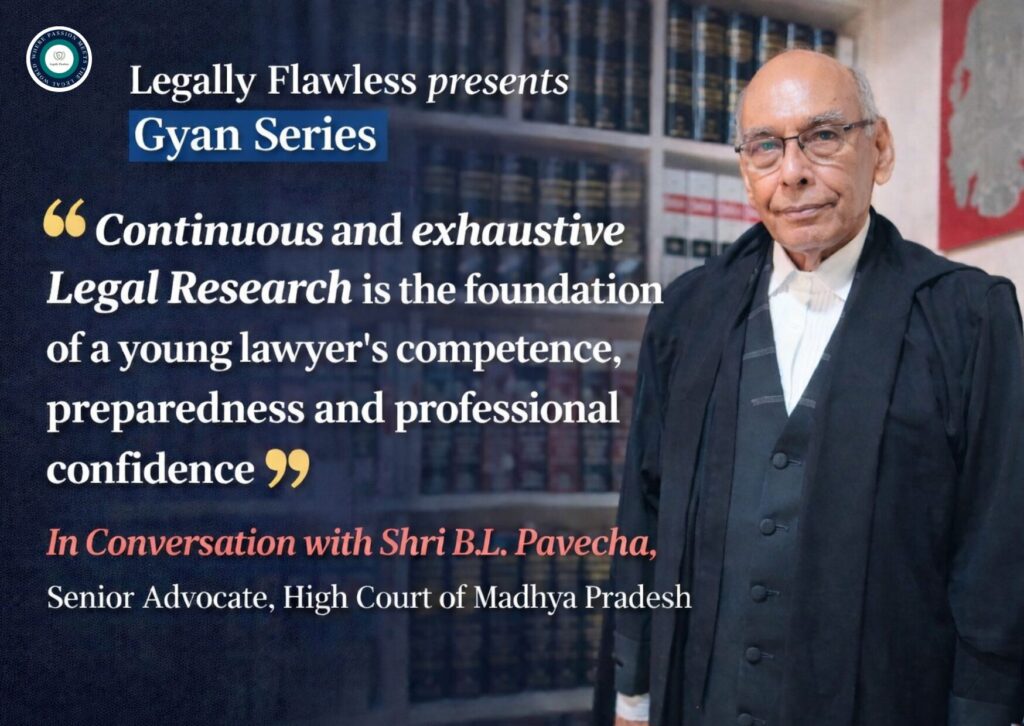
A young lawyer should always be mentally prepared for exhaustive research on the law relevant to his brief. This research will equip him to meet the challenges faced by him in cases of like nature which may fall to his lot and his confidence level would also improve. The research must be in respect of the statutory provisions as also the relevant case law. Research of case law cannot be endless and must be stopped after getting an Apex court decision on the point.
Could you share one particularly memorable case where you felt deeply invested and witnessed a bold and courageous side of the Bench? What did that experience teach you about the justice delivery system?
Some of such ventures are available in law reports in the Journal parts of 2017, 2018 and 2019 of AIR and 2022-26 of the MPLJ as my memorable cases I to X. Advocacy is the game of wits and outcome of the game is a matter of luck and chance depending upon several uncontrollable factors. I am tempted to narrate an interesting story of a seemingly impossible case.
My client, a truck driver was convicted under Section 304-A IPC and sentenced to two years of Rigorous Imprisonment as a punishment in a horrifying motor accident. His truck collided with a bus coming from the opposite direction on a narrow road. It was a hot summer of May and a passenger was having a comfortable nap with his head outside the bus from out of the window. As a result of the collision with the rear angle of the truck his neck was smoothly cut and after the collision the neck was on the road and the rest of the body was in the bus. The conviction was concurrent and I was before Justice J.S. Verma (later CJI) in Criminal Revision, well known for his stiffness in criminal matters. I was not hopeful of getting any hearing in the matter and was sure that the judge would throw away the file with a frown. After hearing the story, Justice Verma expressed “what is there in the case, I see nothing”. My reply with all humility at my command was: sir if the law of the land is that whenever a citizen loses his life in a motor accident some other should necessarily suffer imprisonment regardless of his guilt or innocence, I have no case. Quick came the reply from Justice Verma, that cannot be the law of the land, but in this case your client failed to maintain the duty of keeping safe distance from the vehicle coming from the opposite direction. I replied that, in this case the degree of the duty to keep the safe distance lay much higher on the driver of the bus who was carrying live passengers and not on the truck driver who was carrying the dead load in his truck.” What happened to the bus driver was the next judicial query to which I submitted that the bus driver was neither arrested nor prosecuted and the applicant suffered the spot justice at the hands of the crowd out to smash his bones. To a great surprise, the learned judge (who was himself aged 42 and was moving in a self-driven car till his recent elevation) was persuaded to hold that the bus driver was responsible for the mishap. He instantaneously dictated the order acquitting the applicant.
All efforts are made to ensure the accuracy and correctness of the information published at Legally Flawless. However, Legally Flawless shall not be responsible for any errors caused due to oversight or otherwise. The users are advised to check the information themselves.